
Key Points
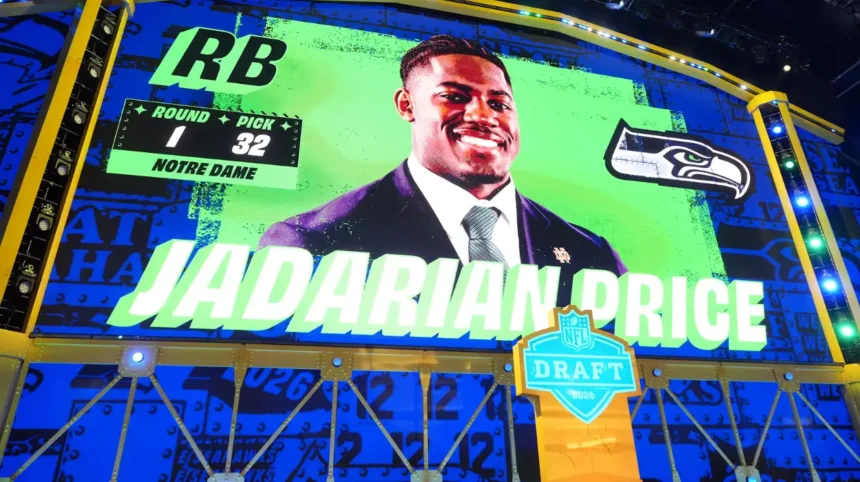
- The Seattle Seahawks selected Notre Dame running back Jadarian Price with the No. 32 overall pick in the 2026 NFL Draft.
- Price was one of just two running backs taken in the first round, joining his college teammate Jeremiyah Love, who went No. 3 overall to the Arizona Cardinals.
- At Notre Dame, Price served as the clear backup to Love yet still produced at a high level, totaling 1,692 rushing yards and 21 touchdowns across three seasons, with about 6.0 yards per carry.
- After the 2024 season, Price received multiple off‑campus offers and large NIL opportunities, including interest from programs in his home state of Texas and from Bill Belichick’s North Carolina team, but he chose to stay at Notre Dame.
- In an interview with Brock and Salk on Seattle Sports 710 AM, Price explained that he stayed at Notre Dame to finish his degree, compete for a national championship, and prove he was on the same level as Love, even though it meant taking less money.
Seattle (King County Insider ) April 27, 2026 – The Seattle Seahawks like players who are not afraid of competition, and they believe they have found that profile in their first‑round pick of the 2026 NFL Draft, running back Jadarian Price of Notre Dame. As reported by Nick Miller of Sports Illustrated’s Seahawks coverage, Seattle used the No. 32 overall selection on Price, solidifying a backfield role that had been left open after the departure of Super Bowl‑champion standout Kenneth Walker III and the season‑ending injury to another top back. After the pick, Price walked into the Brock and Salk studio on Seattle Sports 710 AM for his first extended interview as a Seahawk, and it was there that he detailed why he once turned down what he described as “life‑changing” NIL money to remain at Notre Dame.
Why did the Seahawks pick Jadarian Price at No. 32?
At Notre Dame, Price shared the backfield with Jeremiyah Love, who was widely regarded as the best running back in college football and went No. 3 overall to the Arizona Cardinals. Despite rarely starting, Price generated 1,692 rushing yards and 21 touchdowns over roughly three seasons, averaging close to 6.0 yards per carry, a rate that several draft analysts flagged as “NFL‑ready speed and efficiency.” As reported by Ian Rapoport of NFL Network’s draft coverage, the Seahawks had considered trading back from No. 32 but ultimately decided to use the pick to directly address a pressing need at running back, drafting a player who had “zero tread on the tires” and minimal workload burn.
In an article on Seattle Sports’s site, reporter Stacy Rost wrote that the Seahawks’ choice of Price “says something about the team’s tolerance for competition and its willingness to bet on upside over polished résumés.” Mike Macdonald, Seattle’s head coach, told reporters at the draft combine that the Seahawks watched how calmly Price handled his backup role behind Love and still delivered explosive runs, and that balance between humility and confidence appealed to the staff. Macdonald added that Price’s willingness to stay at Notre Dame for four years, even after the team’s national‑championship runner‑up run in 2024, informed the team’s view of his long‑term makeup.
Why did Price stick with Notre Dame instead of going elsewhere?
After the 2024 national‑title game, Price became a “hot commodity” on the transfer market, clocking multiple top‑level NIL deals and interest from high‑profile programs, according to On3’s coverage of college football. As reported by Tyler Horka of On3, Price had already built a portfolio of name‑image‑and‑likeness connections that included brands such as Powerade, a major trading‑card company, and celebrity jeweler Johnny Dang, which alone would have underpinned a substantial income. At the same time, schools in his home state of Texas and Bill Belichick’s North Carolina Tar Heels were also linked to the possibility of persuading Price to transfer, as outlined in broader recruiting‑news pieces.
During his appearance on Brock and Salk, Price told hosts Brock Huard and Mike Salk that he saw those opportunities but still chose to stay at Notre Dame.

“I committed to Notre Dame and it’s the best decision in my life, really,”
Price said, as summarized in the Seattle Sports feature.
He explained that he wanted to finish his degree, compete for a national championship once more, and “prove to myself that I was just as good as the best running back and the best player in college football,” a reference to Love. Price added that he had to “trust my gut” in the face of offers that promised far more immediate money, and he acknowledged that the decision was not easy given the financial stakes.
How did NIL money and family play into his decision?
According to a profile by The News Tribune’s Brett Loh, Price was raised by a single mother, Jessica Butler, who was diagnosed with breast cancer when he was 12 years old. Butler gave birth to Price when she was 17 and later raised him and his two younger sisters, Kzaria and Lyricah, on her own while battling the disease. Price has repeatedly called her “my rock” and credited her for instilling the discipline and work ethic he brought to football.

In the Brock and Salk interview, Price said that learning how much money he was being offered from other schools and NIL arrangements made the decision harder because he felt the weight of providing for his family.
“It’s bad when you when you don’t come from much and then your mom hears the offer they’re giving you up front,”
Price said, as relayed by the Seattle Sports piece.
He recalled telling his mother that he had a plan to stay at Notre Dame even though it would mean earning roughly “half of what this life‑changing money is,” but he believed that plan would ultimately pay off. Price later noted that Butler, who is now 11 years cancer‑free, has been able to attend his games, drive him and his sisters to practices, and continue motivating the family, which he said reinforces his choice to prioritize stability and long‑term goals.
Sports‑media outlets such as Sports Yahoo and SI.com have highlighted that Price’s collection of NIL deals easily would have placed him in the upper tier of college‑football earners had he transferred to a one‑back program, yet he still chose to stay at a school where he knew he would again share the backfield. In an article for SI.com, Nick Shepkowski wrote that Notre Dame’s ability to retain a highly marketable backup such as Price even in the NIL era could become a selling point in future recruiting, showing that players can still thrive commercially without changing schools.
What does Price’s ‘challenge’ mindset mean for the Seahawks?
In the 2025 season, Price ran for 674 yards on 113 carries and scored 11 rushing touchdowns, according to NFL.com’s draft coverage, all while sharing early‑down work with Love. Analysts at ESPN’s Seahawks draft‑analysis desk have noted that, while Price has limited experience as a true workhorse, his 6.0‑yard‑per‑carry average and low‑mileage usage profile suggest he could handle a heavier NFL workload once he arrives in Seattle. Macdonald told reporters after the draft that the Seahawks see Price as a potential co‑RB1 in a three‑back rotation alongside a power runner such as Zach Charbonnet and another versatile back, and that his special‑teams ability, including kickoff returns, was also a factor in the pick.
Bruce Feldman of Sports Illustrated’s NFL coverage wrote that the Seahawks’ front office viewed Price’s desire to stay at Notre Dame as evidence of “mental toughness and self‑discipline,” traits that align with the organization’s emphasis on players who embrace competition rather than shy from it. In an opinion piece for Seattle Sports, staffer Stacy Rost argued that Price’s choice to stay at a high‑profile program, even in a backup role, signals “a long‑term mindset” that could help him adapt to the power‑hitter style of the Seahawks’ modern offense.

Background of the particular development
At Notre Dame, Price split carries with Jeremiyah Love from 2023 onward, appearing in 41 games over three seasons and never reaching 15 carries in a game more than once, according to NFL.com’s draft‑analysis notes. That limited workload kept his body relatively fresh but also left questions about how he would handle a 20‑plus‑carry workload over a full NFL season. Even so, his production per touch routinely mirrored that of starter‑level backs, with his 6.0‑yard‑per‑carry average and 21 career touchdowns drawing consistent praise from draft‑evaluation services.
The broader context of the NIL era adds another layer: as reporting by On3 and Sports Yahoo has shown, many high‑profile running backs in 2025 chose to transfer to programs that promised larger roles and higher earning potential rather than sticking with a shared‑backfield setup. Price’s choice to remain at Notre Dame, despite those pressures, became a narrative that multiple outlets wrapped into his draft profile, often citing his family background and the belief that staying at one school for four years could translate into a more stable professional transition.
Prediction: How might this decision affect Seahawks fans and the organization?
For Seahawks fans, the pick validates a growing theme in the team’s recent roster construction: emphasizing players who display resilience, long‑term planning, and a willingness to prove themselves in competitive environments. If Price can handle a 15–20‑touch workload while adding value as a special‑teams contributor, his ceiling could exceed that of a typical first‑round backup, giving Seattle greater depth at a position that has proved vulnerable to injuries in recent seasons.
For the Seahawks’ front office and coaching staff, Price’s history of staying at Notre Dame despite big‑money offers could reinforce their interest in similar profiles, especially at positions where the team needs to rebuild depth. Over time, that could influence how the Seahawks market themselves to younger recruits and prospects, framing Seattle as a destination for players who prioritize long‑term development over short‑term financial gain. For the club, Price’s selection may serve as a case study in balancing market‑driven decisions with a more traditional team‑first culture, at a time when NIL money and player movement continue to reshape the college‑to‑NFL pipeline.