

Key Points
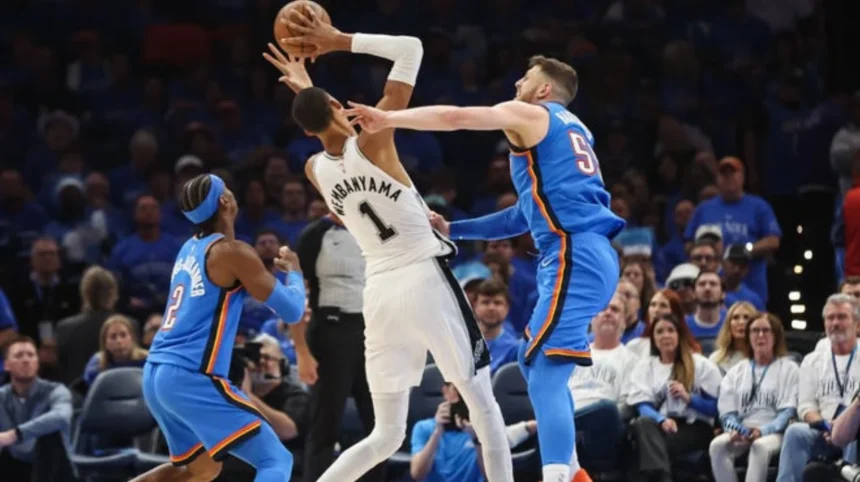
- The Oklahoma City Thunder defeated the San Antonio Spurs 122-113 in Game 2 of the 2026 Western Conference finals on May 20.
- The series is now tied 1-1 as it shifts to San Antonio for the next games.
- Two-time MVP Shai Gilgeous-Alexander scored 30 points and recorded nine assists after struggling in Game 1.
- Victor Wembanyama finished with 21 points and 17 rebounds but appeared fatigued late in the game.
- The Spurs committed 21 turnovers for the second consecutive game, leading to a major disadvantage in points off turnovers.
- Spurs guard Stephon Castle committed multiple turnovers while handling expanded playmaking duties.
- Thunder coach Mark Daigneault adjusted the defensive strategy by assigning Isaiah Hartenstein to defend Wembanyama more frequently.
- Injuries became a growing concern after Jalen Williams and Dylan Harper both exited or dealt with apparent physical issues during the game.
- Spurs guard De’Aaron Fox remained unavailable because of right ankle soreness.
Inverted Pyramid Style
How Did the Thunder Respond in Game 2 of the Western Conference Finals?
Oklahoma City (King County Insider) May 21, 2026. The Oklahoma City Thunder responded strongly in Game 2 of the 2026 Western Conference finals, defeating the San Antonio Spurs 122-113 on Wednesday night to level the series at one game apiece before the matchup moves to San Antonio.
After facing criticism for offensive inefficiency and defensive lapses in the series opener, the Thunder delivered a more controlled performance led by Shai Gilgeous-Alexander, who scored 30 points and added nine assists. Oklahoma City also capitalized heavily on San Antonio’s turnovers, continuing a trend that emerged in Game 1.
The result shifted momentum in the series while also raising fresh concerns about injuries and fatigue on both rosters.
Why Were Turnovers Such a Major Problem for the Spurs?
One of the defining themes of the game was San Antonio’s inability to protect possession.
As reported in postgame coverage, the Spurs committed 21 turnovers for the second straight game. Oklahoma City, by comparison, turned the ball over only nine times. The Thunder converted San Antonio’s mistakes into a 27-10 advantage in points off turnovers.
Fourteen of the Spurs’ turnovers reportedly came directly from Thunder steals, highlighting Oklahoma City’s defensive pressure throughout the contest.
Much of the scrutiny fell on Spurs rookie guard Stephon Castle, who has assumed expanded ball-handling responsibilities due to injuries affecting San Antonio’s backcourt rotation. Castle reportedly accumulated 20 turnovers across the first two games of the series.
The increased workload came after De’Aaron Fox missed both conference finals games because of right ankle soreness. In addition, Dylan Harper exited Game 2 in the third quarter with a right leg injury.
Following the game, Spurs coach Mitch Johnson acknowledged the turnover concerns and discussed possible adjustments.
As reported by multiple media outlets covering the game, Johnson said the coaching staff would continue helping Castle improve his decision-making under pressure, particularly when fatigue becomes a factor.
Johnson stated that Oklahoma City’s defense consistently crowded the paint and presented multiple defenders to disrupt passing lanes and ball movement. He also emphasized that the turnover issue extended beyond one player and affected the entire team.
Castle reportedly accepted responsibility for several mistakes, but the Spurs’ offensive structure has clearly been affected by injuries to key guards.
How Did Shai Gilgeous-Alexander Bounce Back After Game 1?
After struggling against double-team coverage in the series opener, Shai Gilgeous-Alexander delivered a significantly more efficient performance in Game 2.

The Thunder guard scored 30 points while facilitating the offense with nine assists. He appeared more comfortable attacking gaps in the Spurs’ defense and handled San Antonio’s defensive pressure more effectively than he did in the first game.
Oklahoma City’s offensive rhythm improved throughout the contest, especially during stretches when the Thunder forced turnovers and generated transition opportunities.
Gilgeous-Alexander’s response was particularly important because the Thunder needed greater offensive stability after narrowly losing Game 1 despite entering the series as one of the Western Conference’s top-performing teams.
The MVP’s ability to adjust to defensive schemes may remain one of the central storylines as the series continues.
How Did Oklahoma City Change Its Defensive Strategy Against Victor Wembanyama?
A major tactical development in Game 2 involved how the Thunder defended Victor Wembanyama.
In Game 1, Oklahoma City frequently used wing defenders such as Alex Caruso and Jalen Williams against Wembanyama. That approach allowed the Spurs star to dominate near the basket.
According to postgame analysis, 12 of Wembanyama’s 14 made field goals in the opener came inside the restricted area.
For Game 2, Thunder coach Mark Daigneault adjusted by assigning center Isaiah Hartenstein as the primary defender on Wembanyama for extended stretches.
Hartenstein used his physical strength to push Wembanyama farther from preferred scoring positions and challenge him more aggressively in the paint.
Although Wembanyama still recorded 21 points and 17 rebounds while shooting 8-for-16 from the field, the physical nature of the matchup appeared to wear him down during the final quarter.
The Spurs star scored only four points in the fourth quarter and shot 2-for-7 during that period.
As reported after the game, Daigneault explained that Oklahoma City wanted to reduce the number of easy scoring opportunities Wembanyama received near the rim. He also noted that the Thunder were unlikely to rely exclusively on one defensive matchup throughout the remainder of the series.
Daigneault added that the team’s rotation decisions were also influenced by injury concerns involving Jalen Williams.
The tactical battle surrounding Wembanyama’s offensive role is now expected to remain central to the series moving forward.
What Injury Concerns Emerged During Game 2?
Injuries became another major storyline during the contest.
Thunder forward Jalen Williams appeared to aggravate a left hamstring injury that had reportedly sidelined him for approximately six weeks earlier in the postseason.
Meanwhile, Spurs rookie Dylan Harper exited during the third quarter after sustaining a right leg injury.
Neither organization provided definitive postgame updates regarding the severity of the injuries.
The Spurs are already managing the absence of De’Aaron Fox, whose right ankle soreness has kept him out for the opening two games of the conference finals.
The availability of Harper and Fox could significantly influence San Antonio’s offensive structure because both players contribute heavily to ball-handling and shot creation.
For Oklahoma City, Williams remains an important two-way contributor whose versatility affects both perimeter defense and offensive spacing.
As the series shifts to San Antonio, both coaching staffs may need to carefully balance competitive urgency with long-term player health considerations.
What Does the Series Look Like Heading Into San Antonio?
With the series tied 1-1, the Western Conference finals now move to San Antonio for Game 3.
The Spurs succeeded in splitting the first two games on the road, which is generally considered a positive outcome for a lower-seeded team in a playoff series. However, their turnover issues remain a serious concern.
Oklahoma City demonstrated in Game 2 that it can convert defensive pressure into rapid scoring runs, especially when San Antonio struggles to maintain offensive organization.
At the same time, the Thunder still face questions regarding how consistently they can contain Victor Wembanyama over a full series.
Both teams are also entering a potentially delicate stage regarding injuries, with uncertainty surrounding several important contributors.
The next games in San Antonio may determine whether Oklahoma City’s defensive adjustments become sustainable or whether the Spurs can regain offensive balance on their home floor.
Background: Why Has This Western Conference Finals Matchup Drawn So Much Attention?
The 2026 Western Conference finals have attracted significant attention because they feature two franchises built around emerging NBA stars.
The Oklahoma City Thunder entered the postseason with championship expectations behind the leadership of Shai Gilgeous-Alexander and a deep young roster developed through years of rebuilding.
Meanwhile, the San Antonio Spurs advanced behind the rapid development of Victor Wembanyama, whose performances throughout the season strengthened his reputation as one of the league’s most influential young players.
The series has also become notable for its contrasting styles. Oklahoma City relies heavily on defensive pressure, pace, and perimeter versatility, while San Antonio’s offense often revolves around Wembanyama’s interior scoring and matchup advantages.
Injuries to key players, including De’Aaron Fox and Jalen Williams, have further shaped the tactical direction of the matchup.
Prediction: How Could This Development Affect NBA Fans and the Rest of the Series?
The developments from Game 2 could significantly influence both fan expectations and the competitive balance of the Western Conference finals.
For NBA audiences, the series is increasingly becoming a matchup defined by adjustments rather than individual performances alone. Oklahoma City’s success in limiting easier opportunities for Victor Wembanyama may force San Antonio to redesign parts of its offensive approach entering Game 3.
At the same time, continued turnover struggles could place additional pressure on younger Spurs players handling expanded responsibilities because of injuries.
For Thunder supporters, the improved play of Shai Gilgeous-Alexander in Game 2 may reinforce confidence that Oklahoma City can regain control of the series if its defensive intensity remains consistent.
However, the injury situations involving Jalen Williams, Dylan Harper, and De’Aaron Fox could alter rotations and affect competitive depth for both teams.
As the series shifts to San Antonio, the outcome may increasingly depend on which team adapts more effectively to physical play, defensive adjustments, and player availability over the coming games.