
Key Points
- Two teenage suspects opened fire at the Islamic Center of San Diego on Monday, killing three men before killing themselves a few blocks away, according to the Associated Press report by Gene Johnson and contributing AP writers.
- San Diego Police Chief Scott Wahl said investigators are treating the attack as a hate crime and found evidence of “generalized hate rhetoric,” but he declined to give more detail.
- Police were already searching for one of the teens after his mother reported he was suicidal and had run away; investigators later linked the search to missing weapons and a missing vehicle.
- Officers used automated license plate readers and other technology as they searched for the suspects, while also alerting a mall and a school connected to the teens.
- A mosque security guard was among the dead, and police said his actions likely prevented the attack from becoming worse.
- The Islamic Center of San Diego said its mission includes worship, education, and interfaith community work, and the mosque’s director called the attack “extremely outrageous.”
- The Council on American-Islamic Relations condemned the shooting, and President Donald Trump called it a “terrible situation.”
How did the attack unfold?
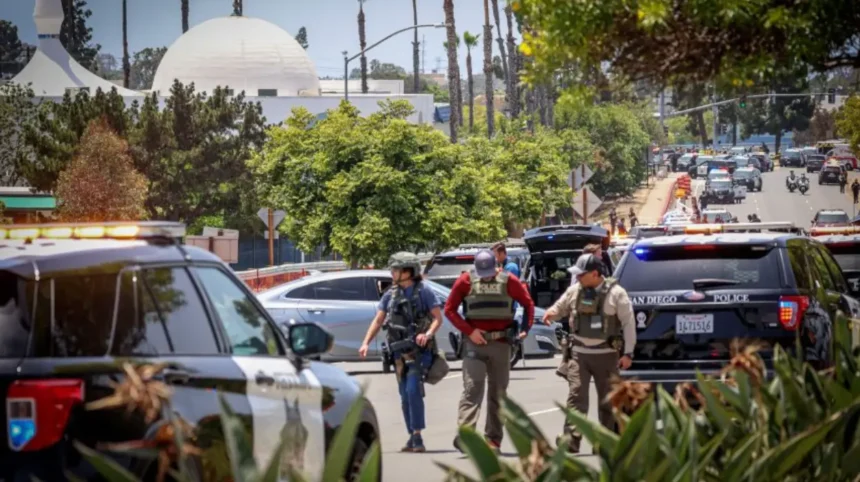
San Diego (King County Insider) May 19, 2026. Two teenage gunmen opened fire at a mosque in San Diego on Monday, killing three men and then taking their own lives nearby, in a case police are investigating as a hate crime.
What did police say?
As reported by Gene Johnson of the Associated Press, police said there was no specific threat made against the Islamic Center of San Diego, but investigators found evidence of “generalized hate rhetoric.” Chief Scott Wahl said the circumstances leading up to the attack would become clearer in the coming days. He also said officers were already looking for one of the suspects before the shooting because his mother had reported that he was suicidal and had run away.
Why were police already searching?
According to the AP report, the search intensified because police learned the teen was dressed in camouflage and was with an acquaintance, which did not fit what officers expected in a possible suicide situation. Wahl said investigators tracked the vehicle through automated license plate readers and sent officers to a nearby mall and school while they continued speaking with the mother. During that search, officers received the call about the shooting at the mosque.
Who were the victims?
Police said one of the people killed was a mosque security guard who “played a pivotal role” in limiting the damage. Wahl later described the guard’s actions as heroic and said, “Undoubtedly he saved lives today.” A family friend identified the guard as Amin Abdullah, who had worked at the mosque for more than a decade, according to the AP report. The names of the other two victims were not immediately released.
What happened at the mosque?
The Islamic Center of San Diego is the largest mosque in San Diego County and also includes the Al Rashid School, which offers classes in Arabic language, Islamic studies, and the Quran for students ages 5 and older, according to the AP account. Police said they responded within four minutes of the emergency call. As officers arrived, gunfire was reported again a few blocks away, where a landscaper was shot at but not injured. The two suspects were later found dead in a vehicle stopped in the road nearby.

How did the community respond?
Imam Taha Hassane, director of the mosque, called the attack “extremely outrageous to target a place of worship.” He said places of worship should be protected and noted that a group of non-Muslims had toured the mosque earlier that same day to learn about Islam. The mosque said on its website that it works not only for the Muslim community but also on education, charity, and broader community service. CAIR-San Diego condemned the shooting and said no one should fear for their safety while attending prayers or studying at an elementary school.
What is the background of this development?
The Islamic Center of San Diego has long positioned itself as both a religious and community institution, with five daily prayers, educational programs, and interfaith outreach. That background matters because the attack hit not only a mosque, but also a school and a gathering place that serves children, families, and visitors from outside the Muslim community. Police have said they are still piecing together the motive and the events that led to the shooting, including the role of the suspects’ online or offline rhetoric.
What could happen next?
For Muslim families in San Diego and similar audiences elsewhere, the immediate effect may be heightened concern about safety at places of worship and religious schools. For mosque leaders and community groups, the case may bring more focus on security planning, emergency response, and interfaith outreach in the weeks ahead. For law enforcement, the investigation could shape how hate crime allegations are assessed in attacks involving houses of worship and young suspects.