
Key Points
- Scottie Scheffler shot 1-over 73 in the opening round of the Memorial Tournament at Muirfield Village Golf Club in Dublin, Ohio, leaving him six shots behind the leaders, according to Golf Channel’s Steve Coulter and the PGA Tour’s coverage.
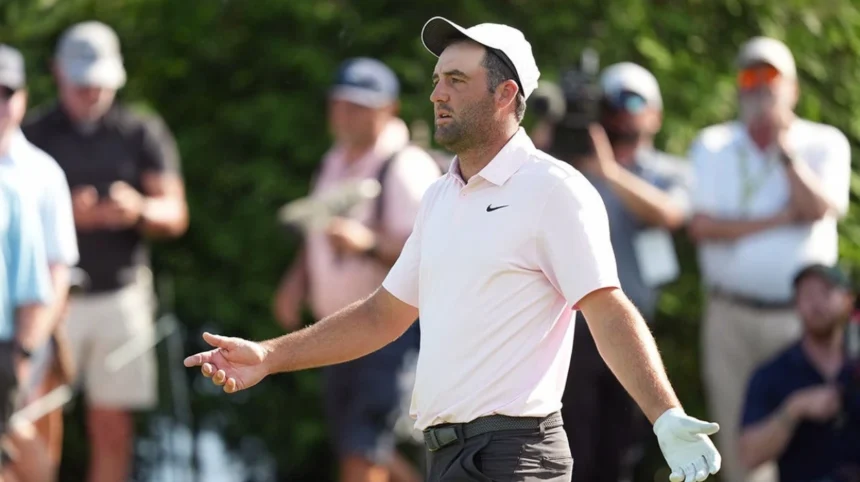
- The strongest moment of frustration came on the par-3 16th hole, where Scheffler’s tee shot went into the water after he and caddie Ted Scott misread the wind.
- Cameras caught Scheffler saying, “I don’t know what to do,” and, “I’m hitting good shots and now dropping from hazards,” during the exchange with Scott, as reported by Steve Coulter of Golf Channel.
- After the round, Scheffler said the wind changed from “down off the right” to “pretty significantly in off the right,” which he said made the shot harder to judge.
- He added that he would rather have the wind come from the left in that situation and said it was frustrating to hit what felt like a good shot and still end up in the drop zone.
- Scheffler birdied the 17th hole after the 16th-hole double bogey, but the late bounce did little to change the scorecard.
- The round came during Scheffler’s bid for a third straight Memorial title, which added to the importance of the opening day result.
What happened in Dublin?
Dublin, Ohio (King County Insider) June 4, 2026. Scottie Scheffler opened the Memorial Tournament with a round that mixed solid stretches with a costly mistake on the back nine, and the biggest story of the day became his visible frustration after the par-3 16th hole. As reported by Steve Coulter of Golf Channel, Scheffler finished with a 1-over 73 and was left six shots back of the early pace, a position that made the round more disappointing for the world’s top-ranked player than disastrous.
The opening round began with enough promise to keep Scheffler in touch, but the back nine brought the kind of error that can change a tournament quickly. According to Golf Channel, the defining moment came when his tee shot on No. 16 found the water after he and Ted Scott judged the wind incorrectly. The result was a double bogey that pushed him to 4 over for the back nine and made the rest of the round a recovery exercise rather than a push up the leaderboard.
Why did the 16th hole matter?
The 16th hole mattered because it showed both the fine margins of elite golf and the pressure that comes with expectation. As Steve Coulter reported for Golf Channel, Scheffler was visibly agitated and told Scott, “I don’t know what to do,” after the shot went into the water. He also said, “I’m hitting good shots and now dropping from hazards,” showing that his frustration was tied not just to the result, but to the feeling that the shot should have been safe.
Scheffler later explained that the wind had changed direction and strength, making the club-and-line decision more difficult than it appeared from the tee box. In his post-round comments, he said the wind switched from “down off the right” to “pretty significantly in off the right,” which altered how the shot played in the air. He added that if the wind had stayed down off the right, the ball likely would have finished near the wedge shot he had in mind from the drop zone.
That detail is important because it shows the difference between execution and outcome in tournament golf. Scheffler said he felt he had hit a good shot, but the wind and the course punished the margin for error anyway. Golf Channel’s reporting framed the moment as a rare but revealing flash of emotion from a player who is usually described in terms of consistency and control.

What did Scheffler say afterward?
Scheffler’s comments after the round stayed focused on the shot itself rather than the emotional exchange. He said he would rather have been gusted in from the left instead of from the right in that situation, because the latter wind direction made the target more difficult to control. He also said the experience was frustrating because he believed he was hitting good shots and still ended up in the drop zone.
According to Golf Channel, Scheffler also reflected on the contrast between the bad break on 16 and the birdie he made on No. 17. He called the better bounce on 17 more fun than the previous hole’s outcome, but he also noted that golf can be frustrating when a solid shot turns into a penalty situation. That sequence helped explain why the scorecard did not fully match the way he may have felt he struck the ball on the day.
The tone of his remarks suggested irritation with the result, but not a broader collapse. He did not describe a mechanical breakdown or a long-term concern about his game. Instead, he pointed to the specific challenge of wind judgment on a difficult hole and the disappointment that comes when a good swing does not produce the expected result.
How did the round affect his position?
Scheffler’s opening-round 73 left him tied for 33rd and six shots behind the leaders, according to Golf Channel’s report. That position does not eliminate his chances, but it does place pressure on the next rounds if he wants to contend for another Memorial title. The score also mattered because he entered the tournament as the defending champion and the favorite in many eyes.
The Memorial has also been one of Scheffler’s strongest events in recent years, which made the opening round stand out more than it might at another tournament. Golf Channel noted that he was attempting a three-peat at Jack’s Place, a level of success that set a high standard for the week. A single over-par round is not unusual in a difficult venue, but it becomes more notable when it comes from the world No. 1 and defending champion.
What did different outlets report?
Multiple outlets described the same key sequence in similar terms, especially the misjudged wind and the ball in the water on No. 16. PGA Tour coverage said the frustration “culminated” on the 16th when Scheffler flushed a 7-iron but watched the wind move the ball into the water, leading to a double bogey and a 1-over 73. Golf Channel’s Steve Coulter similarly reported that Scheffler vented at Ted Scott after the shot and later explained that the wind had switched just enough to change the outcome.
Other outlets also highlighted that the round was not simply one bad hole, but part of a day in which Scheffler struggled to separate from the field. Golf Channel reported that he finished with only a modest consolation birdie on No. 17, while the PGA Tour noted that the score left him six shots back of co-leaders. The broad media picture was consistent: Scheffler was not out of the tournament, but the opening round was a setback in his pursuit of another Memorial victory.
Why is this moment notable?
This moment was notable because it was rare to see Scheffler react so openly during a round. Golf Channel’s coverage described him as looking more prepared to battle himself than the field after carding a 73, which is unusual for a player known for calm and steady results. The reaction also drew attention because it involved his caddie, Ted Scott, and because the exchange happened in a high-profile event with title defense stakes.
It also highlighted a basic truth in golf: even top players can make the correct swing and still get the wrong result when conditions change quickly. Scheffler’s own explanation centered on wind direction, a factor that can alter shot shape, carry distance, and landing position even on a clean strike. That is why the story resonated beyond one hole, since it showed how thin the line can be between a routine birdie chance and a double bogey.
Background of the development
The Memorial Tournament is one of the PGA Tour’s most respected stops, and Muirfield Village Golf Club in Dublin, Ohio, is known for demanding precision and patience. Scheffler entered the week as the defending champion and the player many expected to lead the conversation, given his recent run of success at the event.
His 2026 season had already included a win at The American Express, but Golf Channel reported that he had not picked up a second victory over the following four months before arriving at the Memorial. That context made the opening round more important, because the tournament offered both a chance to defend a title and a chance to reassert control in a season that had included quality results without a steady stream of wins.
Prediction for golfers and fans
For golfers, Scheffler’s round is a reminder that wind judgment and course management remain decisive, even for the best players in the world. For fans following the Memorial, the likely effect is a tighter focus on whether he can recover in the next rounds and whether the frustration on Thursday turns into a stronger response on Friday.
For the broader audience, the development may also sharpen attention on how elite golfers handle adversity under television pressure. Scheffler is still within range of the tournament, but the opening-round setback means every shot from here carries more importance if he wants to move back into contention.